GRDC Profitable Yield Frontiers (PYF) investment with CSIRO
The Profitable Yield Frontiers in the Southern LRZ and MRZ project seeks to quantify the economic impact of crop management practices for wheat and barley in the medium and low rainfall zones of the southern cropping region.
The PYF project will provide a physiology-led framework to:
- Set crops up to consistently achieve a higher proportion of their water-limited yield potential.
- Identify the tactical in-season decisions that genuinely add value.
- Reduce the importance of perfection and precision on yield outcomes.
The goal is to develop a responsive agronomic system that increases yields without substantially raising risk or costs for growers. This system will help growers and agronomists set the crop up for the critical period from flag leaf emergence to flowering, where grain quantity and yield is determined.
Using trial sites at Lock and Hart in SA, along with Yarrawonga, Nullawil and Natya in Victoria, the project will validate the start-of-season decisions that connect plant available water with cereal choice, time of sowing and N inputs to maximise biomass and minimise stress as the crop enters its critical period.
It is hoped that this approach will deliver a more robust and reliable management system than one based on reactive decisions made later in the season, when there is less capacity to fundamentally affect yields.
This GRDC investment Hyper Yielding and Profitable Cereals – Quantifying the economic impact of management practices for wheat and barley in medium and low rainfall zones of the southern region is led by CSIRO and brings together researchers, farming systems group, agronomists and communicators through project partners SARDI, EP Ag Research, AirEP, Hart Field Site Group, Adelaide University, Field Applied Research Australia, AgCommunicators, AgInsights, Elders and local advisors. GRDC Project: CSP2404-020RTX
Setting crops up to capture yield potential
Update paper outlining the importance of opening Plant Available Water to crop choice, sowing date, emergence timing, yield and profitability. (GRDC Grains Research Update, Bendigo 24/02/26.)
Achieving water-limited yield frontiers more profitably
Update paper on the role of water use and crop canopy management in setting cereals up for the critical yield-determining period from late stem elongation to 1 week after flowering. (GRDC Grains Research Update, Adelaide 03/02/26.)
How much will this wheat yield? Dr Kenton Porker
Nine different treatments, nine different crop canopies. Which one will yield the most? CSIRO’s Kenton Porker gives his thoughts. (9 October 2026)
Profitable yield frontiers at Hart - Dr Kenton Porker
CSIRO’s Dr Kenton Porker discusses the Profitable Yield Frontiers trials at Hart, SA. Can they achieve 5t/ha wheat there? (9 October 2026)
Dr Kenton Porker
CSIRO Agriculture and Food
Waite Campus, Urrbrae SA 5064

DISCLAIMER: Any recommendations, suggestions or opinions contained in this publication do not necessarily represent the policy or views of the Grains Research and Development Corporation. No person should act on the basis of the contents of this publication without first obtaining specific, independent, professional advice. The Corporation and contributors to this publication may identify products by proprietary or trade names to help readers identify particular types of products. We do not endorse or recommend the products of any manufacturer referred to. Other products may perform as well as or better than those specifically referred to. GRDC will not be liable for any loss, damage, cost or expense incurred or arising by reason of any person using or relying on the information in this publication.
CAUTION: RESEARCH ON UNREGISTERED AGRICULTURAL CHEMICAL USE
Any research with unregistered agricultural chemicals or of unregistered products reported in this document does not constitute a recommendation for that particular use by the authors or the authors’ organisations. All agricultural chemical applications must accord with the currently registered label for that particular agricultural chemical, crop, pest and region.
GRDC National Nitrogen Fixation project with PIRSA-SARDI
The Improving the understanding and the effectiveness of N fixation in pulses in Australia project is focused on improving nitrogen fixation in pulse crops across Australia and helping growers increase crop productivity and reduce reliance on nitrogen fertiliser.
It is an investment of the Grains Research and Development Corporation (GRDC) led by the South Australian Research and Development Institute in collaboration with Adelaide University, Murdoch University, the WA Department of Primary Industries and Regional Development, NSW Department of Primary Industries and Regional Development, Queensland Department of Primary Industries and AgCommunicators.
The project, which runs until the end of 2028, aims to:
- Develop superior inoculant strains for chickpea and mungbean and conduct a review of current G/S groups
- Overcome constraints and develop better agronomic strategies for improved nodulation and N fixation
- Develop a monitoring and evaluation plan on the state of N fixation by both chickpea and mungbean crops
- Disseminate and communicate improved agronomic strategies which maximise inoculation outcomes for the new and current commercial strains.
National initiative to enhance N fixation in pulses
GroundCover article highlighting the investment aims and objectives and the new project team.
(25 September 2024)
New boost for legumes in acid soils
GroundCover article on the two new, high-performing, commercial rhizobia inoculants for Group E and Group F legumes.
(12 April 2024)
The state of nitrogen fixation across Qld – benchmarking data from 50+ paddocks
Update paper on the chickpea nitrogen fixation benchmarking survey conducted across Qld in 2023 and 2024.
(3 March 2026)
New insights into nitrogen fixation
GroundCover article highlighting the chickpea nitrogen fixation benchmarking survey conducted across Qld in 2023 and 2024.
(6 May 2026)
Nitrogen fixation of crop legumes
NORTHERN REGION
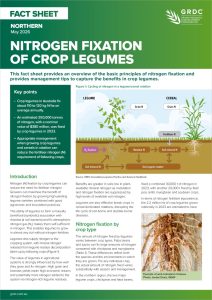
This fact sheet provides an overview of the basic principles of nitrogen fixation and management tips to capture the benefits in crop legumes for the northern region.
Nitrogen fixation of crop legumes
SOUTHERN REGION
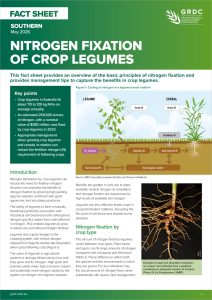
This fact sheet provides an overview of the basic principles of nitrogen fixation and management tips to capture the benefits in crop legumes for the southern region.
Nitrogen fixation of crop legumes
WESTERN REGION
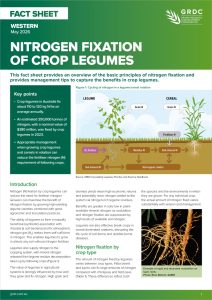
This fact sheet provides an overview of the basic principles of nitrogen fixation and management tips to capture the benefits in crop legumes for the western region.
Inoculating legumes: practice and science
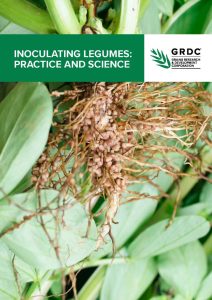
This handbook provides the latest science and practical management knowledge around legume inoculation.
Inoculating legumes: the back pocket guide
This back pocket guide includes information on the benefits of inoculation and tips and tricks for getting it right.
New Group F rhizobia inoculant for faba and broad bean
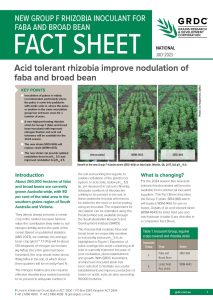
Fact sheet outlining the use and performance of the new acid-tolerant Group F rhizobia strain for use with faba and broad bean.
New Group E rhizobia inoculant for field pea, lentil and vetch
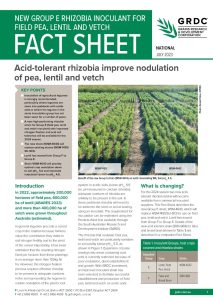
Fact sheet outlining the use and performance of the new acid-tolerant Group E rhizobia strain for use with field pea, lentil and vetch.
Webinar: Making inoculation count
NORTHERN REGION
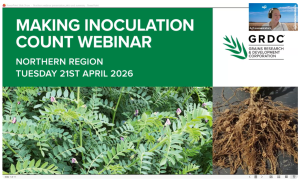
This webinar was held for growers and agronomists in the northern region to provide insights from the national grower survey on legume inoculation practice, held as part of this investment, and tips and tricks for best legume inoculation practice heading into 2026.
(21 April 2026)
Webinar: Making inoculation count
SOUTHERN REGION
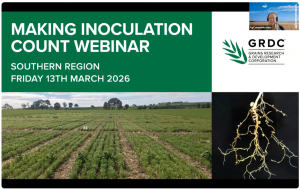
This webinar was held for growers and agronomists in the southern region to provide insights from the national grower survey on legume inoculation practice, held as part of this investment, and tips and tricks for best legume inoculation practice heading into 2026.
(13 March 2026)
Webinar: Making inoculation count
WESTERN REGION
This webinar was held for growers and agronomists in the western region to provide insights from the national grower survey on legume inoculation practice, held as part of this investment, and tips and tricks for best legume inoculation practice heading into 2026.
(27 March 2026)
Dr Liz Farquharson
South Australian Research and Development Institute (SARDI), Department of Primary Industries and Regions
liz.farquharson@sa.gov.au
GRDC Project Code: UOA2312-008RTX
Improving the understanding and the effectiveness of N fixation in pulses in Australia

DISCLAIMER: Any recommendations, suggestions or opinions contained in this publication do not necessarily represent the policy or views of the Grains Research and Development Corporation. No person should act on the basis of the contents of this publication without first obtaining specific, independent, professional advice. The Corporation and contributors to this publication may identify products by proprietary or trade names to help readers identify particular types of products. We do not endorse or recommend the products of any manufacturer referred to. Other products may perform as well as or better than those specifically referred to. GRDC will not be liable for any loss, damage, cost or expense incurred or arising by reason of any person using or relying on the information in this publication.
CAUTION: RESEARCH ON UNREGISTERED AGRICULTURAL CHEMICAL USE
Any research with unregistered agricultural chemicals or of unregistered products reported in this document does not constitute a recommendation for that particular use by the authors or the authors’ organisations. All agricultural chemical applications must accord with the currently registered label for that particular agricultural chemical, crop, pest and region.